Citizens call for renewed efforts under the Great Lakes
Water Quality Agreement
If
turnout is anything to go by, people care about the Great Lakes Water
Quality Agreement. Hundreds of citizens came to public meetings and
participated in a Web dialogue last year, while thousands of others sent
emails, letters and faxes to express their expectations and hopes for
the future of the Agreement. The governments of the United States and
Canada had asked the IJC to seek the public's views before the
governments started their review of the Agreement, which they must
undertake every six years. The governments first signed the Agreement in
1972 and it was last amended in 1987.
The
IJC's recently-released Synthesis of Public Comment
reflects the views of more than 4,000 participants in
this public consultation. Citizens across the basin demanded good water
quality and stressed that clean water is essential to ensure a healthy
future for the lakes as well as the socio-economic well-being of basin
residents and their communities. There was widespread support for the
Agreement as a means for achieving this and participants called on all
levels of government to reinvigorate their efforts to implement the
Agreement. Holding governments accountable for meeting their commitments
was also stressed throughout the basin.
While many participants felt that the
governments should review the Agreement thoroughly, not all thought the
focus should be broader than it is today. Many felt that new provisions
should be added to address a range of issues affecting the ecosystem,
such as aquatic invasive species, land use and watershed management and
interbasin transfers of water. Others said that the Agreement must keep
its focus on the injury from pollution of the waters so it remains an
effective tool for achieving progress.
There was also considerable discussion of
incorporating specific objectives and timetables, along with
strengthening the institutional mechanisms needed to ensure
accountability for achieving the goals of the Agreement. Many
participants pointed to the need for increased monitoring efforts to
better assess progress to restore environmental conditions.
Many comments, especially during the Web
dialogue, called on governments and the IJC to carry out public
education efforts to build support for Great Lakes restoration,
particularly in regard to getting people more involved with water
quality issues in their local communities. The Remedial Action Plans to
restore the local Areas of Concern were often cited as a source of great
hope for making tangible improvements at the community level, but were
also regarded as a great source of frustration due to the slow progress.
Mayors and representatives of municipal governments who attended the
public meetings said that they wanted a more formal voice in the
Agreement process. Overall, the high level of participation and depth of
commentary demonstrated that there is a strong constituency for the
Great Lakes Water Quality Agreement.
The IJC began the public consultation
process with its Biennial Meeting in Kingston, Ontario, in June 2005 and
subsequently held 14 public meetings across the Great Lakes-St. Lawrence
River basin in the fall. A four-day Web dialogue near the end of the
process allowed anyone with access to the Internet to discuss issues
with a panel of experts and citizens in other parts of the basin, as
well as to provide comment.
The
IJC established partnerships with mayors across the basin, who
cooperated enthusiastically by making meeting spaces and equipment
available for the public meetings. A Citizens Advisory Group of 24
leading science and policy experts from both countries helped the IJC
develop a series of consultation questions, as well as an outreach
strategy. The IJC also produced a Guide to the Great Lakes Water
Quality Agreement
that provides
background information to the review by governments.
In addition to holding the early public
consultation process, the IJC will provide the governments with its own
advice on the review of the Agreement in a separate report. The IJC's
advice will be informed by views expressed during the public
consultations and the research, analysis and advice of its policy and
technical committees. These include the Great Lakes Water Quality Board,
Great Lakes Science Advisory Board, Council of Great Lakes Research
Managers and International Air Quality Advisory Board.
The
Synthesis of Public Comment on the Forthcoming Review by the Federal
Governments of Canada and the United States of the Great Lakes Water
Quality Agreement
is available from the
IJC offices and online at www.ijc.org.
The complete record of public comment is available on CD-ROM.
Transcripts of the public meetings are also available on the
website.

|
The IJC
wishes to acknowledge the tremendous contribution to its
consultation process provided by the following mayors
and their staff:
Mayor Herb W. Bergson,
Duluth, Minnesota Mayor Jane Campbell, Cleveland, Ohio Mayor
Richard M. Daley, Chicago Illinois Mayor Eddie Francis,
Windsor, Ontario Mayor William A. Johnson, Jr.,
Rochester, New York Mayor Robert J. Katt, Bay City,
Michigan Mayor Kwame Kilpatrick, Detroit, Michigan Mayor
Jean-Paul L'Allier, Quebec City, Quebec Mayor George J.
MacDonald, Midland, Ontario Mayor David Miller, Toronto,
Ontario Mayor Lynn Peterson, Thunder Bay, Ontario Mayor John
Rowswell, Sault Ste Marie, Ontario Mayor James Schmitt, Green
Bay, Wisconsin Mayor Gérald Tremblay, Montréal,
Quebec
|
The people have spoken: United States and Canada must renew their
commitments to restore water quality
by the Rt. Hon. Herb Gray and Hon. Dennis
Schornack
Public participation is the bulwark of democracy.
For the Commissioners of the IJC, our most recent opportunity to engage
citizens across the Great Lakes and St. Lawrence River basin was an
honor and a privilege. In June of 2005, the federal governments of the
United States and Canada asked the IJC to provide an early opportunity
for public input into the review of the Great Lakes Water Quality
Agreement. We worked with the Mayors and a variety of organizations to
reach out to the communities, and from June to December we held a
conference, 14 regional public meetings and a four-day Web dialogue. The
response was exhilarating. Over 4,000 people came to our meetings, or
participated by letter, email, fax and telephone. Their views are
captured in the Synthesis of Public Comment
report that we have just
released.
The
Great Lakes Water Quality Agreement was first signed in 1972 and last
updated in 1987. It expresses the commitment by our two countries to
restore and maintain the chemical, physical and biological integrity of
the waters of the Great Lakes basin ecosystem and has resulted in a
notable cooperation and progress. The citizens of both countries told us
that they want governments at all levels to reinvigorate their efforts
to achieve the goals of the Agreement. They delivered a strong message
that good water quality is not only essential for a healthy ecosystem,
but also for their jobs, quality of life and the overall health and
well-being of the basin's residents and their communities. Most wanted
the review to look beyond the Agreement's current focus on chemical
pollution to address a variety of critical issues such as invasive
species and conservation of wetlands. Change is the only thing that is
permanent, and the Agreement must change if the United States and Canada
wish to continue the progress made over the past 30 years. But citizens
only wanted to broaden the scope if it could be done without losing the
focus on restoring water quality. No one wanted the Agreement to be so
broad that it would be ineffective. Indeed many called for more specific
objectives and deadlines, as well as strengthened mechanisms to ensure
accountability.

Chairmen Gray and Schornack, with Commissioners Blaney,
Brooks and Olson launch the Synthesis of Public Comment Report at Dieppe
Park, Windsor, Ontario, across river from Detroit, Michigan, April 20,
2006.
The
two federal governments have recently begun their review of the Great
Lakes Water Quality Agreement. Restoring and maintaining water quality
in the Great Lakes and St. Lawrence River basin ecosystem will require a
great deal of political will by each country as well as close
cooperation between them. The citizens of both countries have voiced
their support for renewing and strengthening this vital Agreement. Now
is the time to craft the commitments that will guide Canada and the
United States in working together to restore the waters of the world's
premier freshwater ecosystem.
Governments launch review of Great Lakes Water Quality Agreement
The governments of Canada and the United States began
their formal review of the Agreement in March 2006.
They have committed to an open, transparent and inclusive review process that
allows for the involvement of all interested parties.
An Agreement Review Committee (ARC), established by the governments'
Binational Executive Committee, will lead and coordinate the review
process. The ARC, co-chaired by Environment Canada and the U.S. Environmental
Protection Agency, includes representatives of federal, provincial, state, tribal
and municipal agencies. One of the ARC's responsibilities is to develop a
public consultation strategy early in the review process.
Ten Review Working
Groups will be established by the ARC to facilitate
the review of the Agreement. These groups will be composed of experts,
including IJC observers, to address the following topics:
- Scope and purpose, goals and objectives,
function;
- Toxic chemicals;
- Remedial Action Plans and Lakewide Management Plans;
- Phosphorus and non-point source pollution;
- Sediment-related issues;
- Research and monitoring provisions;
- Coast Guard annexes;
- Groundwater issues;
- Third party review of governance provisions and institutions; and
- Special issues.
The work of the Review Working Groups commenced in
late April 2006 and will continue to the end of Calendar Year 2006.
Throughout this process, the ARC will monitor progress, as well as
provide assistance and resolve issues as needed. At the end of the
Agreement review, the results and recommendations of each Review Working
Group, and any other analyses, will be compiled by ARC in a draft
Agreement review report and provided to the Binational Executive
Committee for its consideration.
The Binational Executive Committee will
approve and release the draft Agreement Review Report for a 60-day
public consultation. Review and approval by the relevant agency or
department of each government may be required. The Binational Executive
Committee will then make a formal recommendation to Foreign Affairs
Canada and the U.S. Department of State on what, if any, actions should
occur as a result of the review.
The governments will then consider the
findings and recommendations of the Binational Executive Committee and
determine next steps.
For more
information, visit www.binational.net
or contact Mark Elster, U.S. Environmental Protection Agency, by
phone at (312) 353-2018 or email at elster.mark@epa.gov, or Monica
Lim, Environment Canada, by phone at (416) 739-4787 or email at monica.lim@ec.gc.ca.
Study will examine water levels on Osoyoos
Lake
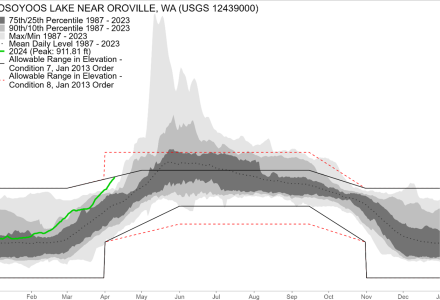
With its current Order of Approval for Zosel Dam,
located in the state of Washington below the outlet of Osoyoos Lake, set
to expire in 2013, the IJC is gearing up for the renewal process. In
early April, the International Osoyoos Lake Board of Control presented
the IJC with a plan of study for investigating issues related to the
regulation of Osoyoos Lake water levels, including several that have
been raised in recent years by basin
residents at the board's annual public meetings. Such issues include the
management of water levels during drought years and
the timing of summer and winter operations. In February, the board also
held two public meetings on the draft plan of study. Participants
at the Osoyoos, British Columbia meeting reiterated their strong concerns over water
quality in Osoyoos Lake and the possible impacts of water
levels regulation. Participants in Oroville, Washington were equally passionate in their concerns
about water supplies.

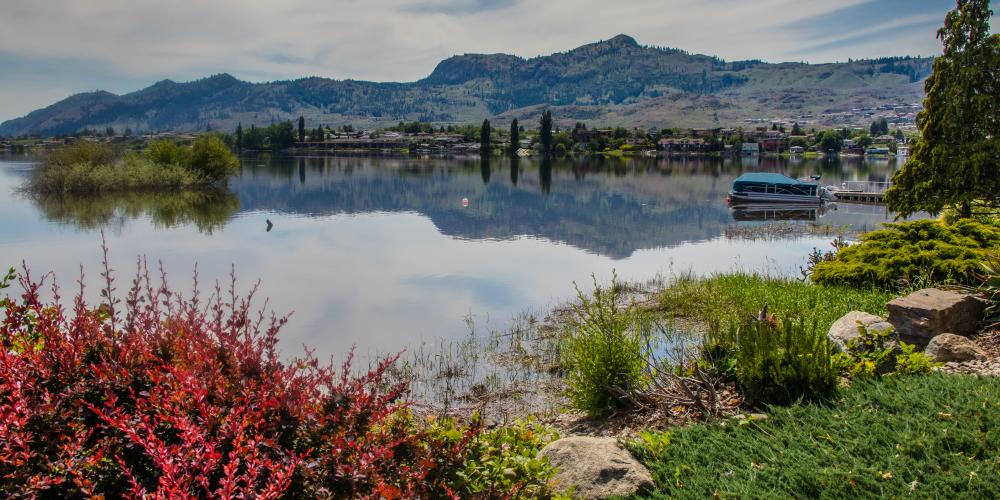
Osoyoos Lake straddles the boundary between
British Columbia and Washington and is of prime importance to
agricultural interests in the region. The lake also serves as a
recreational resource and domestic water supply. Outflows from the lake
are regulated at Zosel Dam, located on the Okanogan River 2.7 kilometres
(1.7 miles) below the lake. The board was established to ensure
implementation of the IJC's 1946 Order of Approval with regard to the
operation of Zosel Dam. The IJC approved the construction of a new Zosel
Dam to replace the former structure in 1982 and issued a Supplementary
Order of Approval in 1985. Actual operation of the dam is conducted by
the Oroville and Tonasket Irrigation District under contract to the
project owner, the State of Washington Department of Ecology.
The Osoyoos Lake board holds an annual
meeting and provides the IJC with a report each April. Monthly reports
of daily lake levels and flows are kept to assure compliance with the
IJC's orders of approval. The board has recommended that the IJC adopt
the Plan of Study and take the necessary steps to fund and implement the
plan. It has also recommended that the IJC take additional steps to
respond to community concerns in the near term. The IJC is considering
the information and advice provided by its board. For more information
about the International Osoyoos Lake Board of Control visit its website
under the "boards" tab at: www.ijc.org.
Comments support progress on air quality, but express
concern about health effects
In
March, the IJC released its Synthesis of Public Comment
on the 2004 Progress Report under the Canada-United States Air Quality
Agreement. Under the 1991 agreement, the IJC is responsible for
inviting public comment on progress reports prepared by a Canada- U.S.
Air Quality Committee that is led by Environment Canada
and the Environmental Protection Agency. The IJC received 35 written
submissions on the 2004 Progress Report and an additional 15
presentations at two consultation meetings. Many submissions were from
provincial, state and municipal agencies, as well as from
professional groups.

Respondents were generally satisfied that progress
has been made by both countries to reduce sulfur dioxide, nitrogen
oxides and volatile organic compounds in the eastern part of
the continent. However, many questioned whether the current sulfur dioxide
and nitrogen oxide reductions were sufficient to promote full recovery of
ecosystems or to protect of human health. While these respondents
found the information on emissions reductions that was provided in the
progress report to be useful, several thought that more
assessment of environmental and health impact trends was needed. Others
stated that adequate data was not provided to support the
conclusion in the 2004 Progress Report that human health
and the environment have benefited greatly from progress under
the Agreement.
Several people also wanted to see the Agreement
address issues that are not currently covered by it, including the
adoption of specific objectives for transboundary particulate matter,
mercury and other persistent toxic substances. Copies of the
Synthesis of Public Comment
on the 2004 Progress Report under the Canada-United
States Air Quality Agreement are available from an IJC office or on the
Web at www.ijc.org.
IJC Role in Souris River basin continues to
evolve
The process to consolidate
the international monitoring and reporting activities in the Souris River basin
continues with recent steps to merge the Souris
River Bilateral Water Quality Monitoring Group with the IJC's International
Souris River Board.
The Souris River originates in Saskatchewan, passes
through North Dakota, and then crosses into
Manitoba before joining the Assiniboine River. Its total length is
approximately 705 kilometres (435 miles). In 1940, the governments
of the United States and Canada asked the IJC to
investigate the regulation, use and flow of the Souris River
and its tributaries and the apportionment of
water between the two countries. The governments approved
the interim measures recommended by the IJC for cross-border sharing of
Souris River waters and the IJC established an
International Souris River Board of Control to monitor compliance with
the interim measures.
As
part of its International Watershed Initiative, and to ensure
a more ecosystemic approach, the IJC formed the International Souris
River Board in 2002 by combining its International Souris River
Board of Control and the Souris River
aspects of its International Souris-Red Rivers Engineering Board.
In addition to overseeing the sharing of water under the interim
measures, the combined board reports on water use
and development activities in the Souris River basin that could
have transboundary impacts.
In 2005, the governments of the United States
and Canada disbanded their Souris River Bilateral Water Quality Monitoring
Group and transferred the responsibility to report on water
quality in the Souris River to the IJC. The International
Souris River Board is currently developing a draft directive for
consideration by the IJC that will include
responsibilities for providing advice on water quality monitoring
and objectives, and annual reporting on water quality in the Souris
River. The International Souris River Board is also
working with the former monitoring group to propose new members
for the board.
IJC gives its International Watershed Initiative a
push
The IJC is moving its
International Watershed Initiative ahead towards on-the-ground results.
Specific projects for the St. Croix River, Red River and Rainy River
watersheds are proposed in a discussion paper, released in December
2005, that focus on strengthening the capabilities of the existing IJC
boards and local organizations in these three
watersheds.

St. Croix River

St. Croix River
Several projects to improve outreach
efforts and the base of information within the watersheds were
identified in the paper by the IJC and its boards. Examples of those
that have received initial funding include a digital watershed mapping
project in the St. Croix watershed and data collection for a hydrologic
and hydraulic model in the Rainy River watershed.

The initiative is based on the premise that
local people, given appropriate assistance, are in the best position to
prevent potential disputes and resolve local transboundary issues.
Looking to the future, the IJC believes that building the capacity to
solve problems at the local level will substantially reduce, and perhaps
eliminate the need to directly involve the two national governments in
resolving international watershed issues. The IJC is hopeful that it can
secure additional funding for a number of these projects. Watch for
updates on this important initiative in future issues of Focus.
Comments on the discussion paper are welcome.
The discussion paper is available from an IJC office or under the
"activities" tab at www.ijc.org .
People
In October, the IJC welcomed Dr. Karen E.
Vigmostad
as Director of its Great Lakes Regional Office in Windsor, Ontario.
Dr. Vigmostad has spent 20 years working on Great Lakes
policy and conservation. Most recently, she served as a
policy analyst with the Northeast-Midwest Institute in Washington, DC, where
she specialized in Great Lakes ecosystem restoration and water management.
She leads a binational collaborative for the
conservation of Great Lakes islands and serves on
the Council of Great Lakes Governors' Annex 2001 Resource Group, the
U.S. Fish and Wildlife Service's Great Lakes Basin
Ecosystem Team and the State of the Lakes Ecosystem Conference
(SOLEC) Advisory Committee.
Dr. Vigmostad was
born and raised in Detroit, Michigan and came to love
the Great Lakes by boating with her
family on Lake St. Clair. She views her
role as finding creative, innovative ways to foster peace between nature
and culture. She looks forward to serving as
director during this critical time for the IJC and the
Laurentian Great Lakes.
The IJC welcomes recent appointments to its
boards and expresses its gratitude to those who contributed their time
and talent to assist Canada and the United States with managing
transboundary environmental issues.
* Council of Great Lakes Research
Managers
|
|
Welcomes :
|
| |
Daniel Bondy
Manager, Environmental and Occupational Toxicology Division
Environmental Health Sciences Bureau
Environmental Health Canada
Dr. Saad Y. Jasim
Chief Executive Officer
Walkerton Clean Water Centre
Dr. Janet R. Keough
Associate Director for Science
National Health and Environmental Effects Research Laboratory
U.S. Environmental Protection Agency
|
|
Completing Service :
|
| |
Dr. Robert Andrews
University of Toronto
Dr. David Blakey
Health Canada
Dr. Patricia Chow-Fraser
McMaster University/International Association for Great Lakes Research
|
* Great
Lakes Water Quality Board
|
|
Welcomes :
|
| |
Alec Denys
Director, Great Lakes Branch
Ontario Ministry of Natural Resources
Thomas W. Easterly
Commissioner
Indiana Department of Environmental Management
|
|
Completing Service :
|
| |
Michael Goffin, as Acting Canadian Co-Chair
Environment Canada, Ontario Region
Mr. David de Launay
Ontario Ministry of Natural Resources
|
* Great Lakes Science Advisory Board
|
|
Welcomes :
|
| |
Dr. C. Scott Findlay
Associate Professor
Institute of the Environment
University of Ottawa
Dr. David R. S. Lean
Adjunct Professor
Biology Department
University of Ottawa
Marcia Valiante
Professor of Law
University of Windsor
|
|
Completing Service :
|
| |
Dr. Pierre Payment
Michigan Technological University
Dr. Bruce Krushelnicki
Burlington, Ontario
David Stonehouse
Manager, Stewardship & Restoration Evergreen
Toronto, Ontario
Dr. Lesbia Smith
Toronto, Ontario
|
* Health Professionals Task
Force
|
|
Welcomes :
|
| |
Dr. Monica Campbell
Manager
Environmental Protection Office
Toronto Public Health
|
* International Rainy Lake Board of
Control
|
|
Welcomes :
|
| |
Peter Williams, P.Eng.
Thunder Bay, Ontario
|
*
International Red River
Board
|
|
Welcomes :
|
| |
Wayne Dybvig, Co-Chair, Canadian Section
Executive Director, Transboundary Waters Unit
Prairie & Northern Region
Environment Canada
Michael J. Ryan, Co-Chair, U.S. Section
Great Plains Regional Director
Bureau of Reclamation
Phil Adkins, P.Eng.
Acting Director
Agricultural Water Directorate
Agriculture and Agri-Food Canada
– Prairie Farm Rehabilitation Administration
Will Haapala
Regional Manager, Northwest Region Office
Minnesota Pollution Control Agency
|
|
Completing Service :
|
| |
Maryanne Bach, Bureau of Reclamation
Dr. Kevin Cash, Interim Co-Chair, Canadian Section
Richard Kellow
Environment Canada
Jeff Lewis
Minnesota Pollution Control Agency
Alain Vermette
Agriculture and Agri-Food Canada
|
* International Souris River Board
|
|
Welcomes :
|
| |
Bob Harrison
Senior Hyrdologist
Water Science and Management Branch
Manitoba Water Stewardship
|
|
Completing Service :
|
| |
Richard J. Bowering
Manitoba Water Stewardship
|
Hot off
the press
- Synthesis of Public Comment on the
Forthcoming Review by the Federal Governments of Canada and the United
States of the Great Lakes Water Quality Agreement
, January 2006.
Reflects the main points and other views of the participants in the
IJC’s public consultations on the forthcoming review. Obtain a copy
from an IJC office or online at www.ijc.org
.
- Synthesis of Public Comment on the 2004
Progress Report under the Canada-United States Air Quality
Agreement
,
December 2005. Conveys the views of organizations and individuals in
Canada and the United States on the progress toward meeting the goals
of the 1991 Agreement and its annexes. Obtain a copy from an IJC
office or online at www.ijc.org
.
- Priorities 2003- 2005, Executive Summary .
A report to the International Joint Commission by its advisory boards
under the Great Lakes Water Quality Agreement on their findings and
recommendations from the 2003-2005 priority cycle. Obtain a copy from
an IJC office or online at www.ijc.org.
- A Discussion Paper on the International
Watersheds Initiative
, June 2005. Proposes
specific initiatives to further develop this initiative. Obtain a copy
from an IJC office or online at www.ijc.org.