Tell the governments your views on transboundary air quality
Your comment is invited on efforts to address transboundary air
quality
The IJC would like to know how well you think the United States and Canada
are
doing to reduce transboundary air pollution under their 1991
Agreement on Air
Quality.
The Agreement, which can be found on the IJC web site at
http://www.ijc.org/rel/agree/air.html
, intends to provide a "practical and effective instrument to address
shared
concerns regarding transboundary air pollution." It also
provides an
opportunity for you to submit comments to the IJC on the
most recent review of
progress, the
2000 Progress Report
, prepared by the governments’ Air Quality Committee.
The
2000 Progress Report
reviews acid rain control programs, monitoring, prevention of air
quality
deterioration, visibility protection, notification,
assessment and mitigation
of significant transboundary air pollution,
and scientific information
exchange. The report also describes
cooperation between Canada and the United
States on ground-level
ozone and particulate matter. You may obtain the
2000 Progress Report
of the Air Quality Committee from the IJC or the following website:
http://www.ec.gc.ca/pdb/can_us/qual/2000/aqa_2000_e.pdf.
In December 2000, after the Progress Report was printed, the two
countries
announced that a new Ozone Annex to the Agreement had been
brought into force.
The Annex sets targets for reducing
smog-producing emissions in both countries.
The full text of the
Ozone Annex can be found at:
http://www.ec.gc.ca/air/ozone-annex_e.shtml
.
The IJC will provide a synthesis of public comments to the two
federal
governments for their consideration in further developing
programs under this
Agreement.
Please send comments by email, fax or letter to either the U.S. or
Canadian
Sections of the IJC by April 30, 2001.
Study of Lake Ontario outflows moves ahead
The International Lake Ontario - St. Lawrence River Study has moved ahead
on
several fronts since the last issue of
FOCUS
. As reported previously, the study will review the criteria set by the IJC
in
1956 for regulating Lake Ontario outflows.
IJC Commissioners have established a 14-member study board with experts
drawn
from various levels of government, academia, Native peoples and
the community
at large. The study board, lead by U.S. co-chair Eugene
Stakhiv and Canadian
co-chair Doug Cuthbert, is responsible for
carrying out the study directive
issued by the IJC and ensuring the
managerial and scientific integrity of the
study.
The IJC has also established a binational 24-member Public Interest
Advisory
Group to further the Commission’s goal of comprehensive
public participation in
the study. The Public Interest Advisory Group
will provide public involvement
guidance, consultation and assistance
to the study board, and periodically
report on its work to the IJC.
An article about this group will appear in the
spring issue of
FOCUS
.
In January, a workshop was held in Montréal to develop a work plan and
budget
for the study, and to form several of the technical work
groups responsible for
conducting various elements of the study. The
groups will deal with such areas
as recreational boating and tourism,
evaluation methodologies, hydrology,
commercial shipping, hydropower,
modeling, shoreline and environment. One group
was formed to ensure
that the data collected in the study serves all of these
efforts. As
in other areas of the study, the working groups are fully
binational
with equal representation from each country.
Two full-time study co-managers will assist the study board with its work.
Mr.
Ed Eryuzlu has been hired as the Canadian co-manager and support
is currently
being provided in the United States by the Buffalo
District of the U.S. Army
Corps of Engineers until hiring for the
U.S. co-manager is completed.
In an effort to leverage resources and take advantage of existing data,
the
study personnel are reaching out to academics, governments at all
levels and
others to coordinate existing studies with the Lake
Ontario-St. Lawrence study.
More information about study activities can be found at
www.ijc.org
.
Members of the International Lake Ontario - St. Lawrence River Study
Board
Dr. Eugene Stakhiv
, U.S. co-chair. Dr. Stakhiv has pioneered the use of modeling as
a
decision-making and public involvement tool in watershed planning.
He is chief
of policy and special studies, U.S. Army Corps of
Engineers Institute for Water
Resources.
Doug Cuthbert
, Canadian co-chair. As water issues division manager, Mr. Cuthbert
is
responsible for Environment Canada’s work on water quantity issues
throughout
Ontario and the Great Lakes.
John Cahill
, as Commissioner, New York State Department of Environmental Conservation,
has
spearheaded Governor Pataki’s efforts to make New York a national
leader in
environmental protection and natural resource management.
Mr. Cahill will be
assisted by Sandra LeBarron, director, Region 6,
New York State Department of
Environmental Conservation.
André Carpentier
is a civil engineer currently in charge of transboundary basins for the
Quebec
Department of the Environment.
Lynn Cleary
has held several management positions in the Canadian Public
Service.
Recently, she was the regional director of the St. Lawrence
Center of
Environment Canada. She is currently the director of the
Biosphere of Montreal.
Ian Crawford
has served as senior advisor on water and natural resource issues to
the
Province of Ontario since 1984. Currently he is manager of water
power
projects, Ontario Ministry of Natural Resources.
Dalton Foster
is a retired biochemist. Long concerned with the ecology of the St.
Lawrence
River, he currently is technical advisor to the
International Water Levels
Coalition. He also serves as U.S. co-chair
of the Public Interest Advisory
Group.
F. Henry Lickers
serves as director, Environmental Division, Mohawk Council of Akwesasne
and
has long worked on Great Lakes and St. Lawrence ecosystem health
issues.
Dr. Daniel P. Loucks
has pursued a distinguished career in many areas of water resources
management
and systems analysis. Currently he is a professor in the
School of Civil and
Environmental Engineering, Cornell
University.
Fred Parkinson
is a hydraulic engineer and private consultant who has led ice, navigation
and
sediment transport studies of the St. Lawrence River and other
waters. He also
serves as Canadian co-chair of the Public Interest
Advisory Group.
Dr. Frank Quinn
is an expert on climate change and senior research hydrologist at the
Great
Lakes Environmental Research Laboratory of the National Oceanic
and Atmospheric
Administration.
Dr. Frank Sciremammano Jr.
is professor of mechanical engineering at the Rochester Institute
of
Technology. His research has focused on long-range water level
forecasting and
mitigating environmental pollution.
Water levels vary along U.S.-Canadian border
Water supply conditions vary this year in the lakes and rivers where the
IJC
has responsibilities for water flows and apportionment. While
current
information on levels in watersheds along the boundary can be
accessed from the
IJC’s website at
www.ijc.org
, notable highlights are provided.
In the Great Lakes basin, the levels of lakes Superior, Michigan and Huron
have
fallen for the fourth year in a row. Lake Superior’s level has
not been lower
at this time of year since 1926, and lakes Michigan
and Huron, which rise and
fall as one lake, have not been lower at
this time of year since the mid-1960s.
All three are expected to
remain below chart datum, a low water reference level
for navigation,
into the month of May. Lake Erie is below average and Lake
Ontario is
near average. Both are above chart datum and above their levels
of
last year. While Lake Erie is likely to remain below average into
the summer,
Lake Ontario may be either slightly above or slightly
below long-term average
levels depending on how wet or dry the
weather is this spring and summer.
Further downstream, the average
level in Montréal Harbour during February set a
new record low.
Levels in Montréal Harbour, while above chart datum, are
expected to
remain well below average for the next few months.
To the west of the Great Lakes, soil moisture remains high in the Red
River
basin due to heavy rains this past fall. Snow cover over most
of the basin is
only somewhat above normal, except for the extreme
southern portions that are
well above normal. There is a minor to
moderate flooding potential over most of
the basin, except for the
extreme southern portions of the basin where the
potential exists for
moderate to major flooding. With normal weather
conditions, minor
agricultural flooding could occur; with unfavorable
weather
conditions, extensive flooding of agricultural lands and
urban flooding could
occur in some areas, particularly in the
southern portions of the basin.
In the Souris River basin, soil moisture and snow cover are both well
above
average. Potential flooding is a concern even with favorable
weather
conditions, and unfavorable weather conditions could produce
moderate to major
flooding in the lower Souris basin. Controlled
releases are being made from
major reservoirs in Saskatchewan and
North Dakota to make flood control storage
available in preparation
for the forecasted above-normal spring runoff. Based
on the snow
pack, the outlook is for below-average stream flow in the St.
Mary
and Milk rivers this spring.
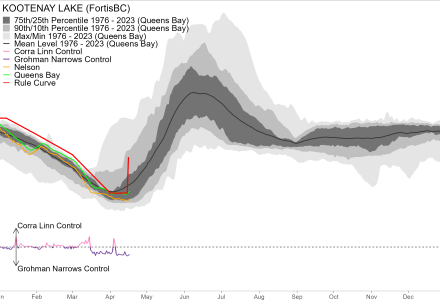
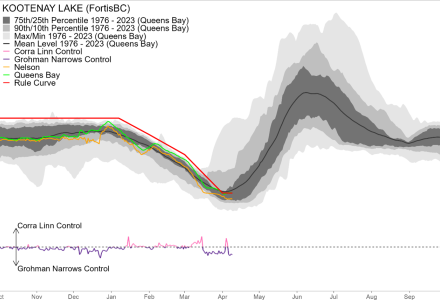
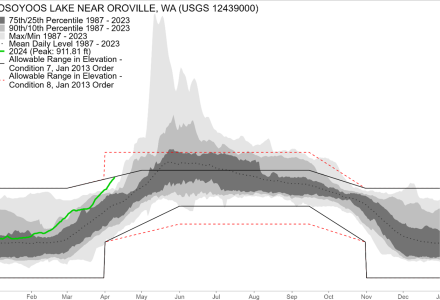
In Idaho, Washington and British Columbia, precipitation during the fall
and
winter 2000-2001 has been at near record low levels. Snow pack
and
corresponding spring and summer runoff in the basins above
Kootenay and Osoyoos
lakes is expected to be about 50 percent of
normal.
Montréal Public Forum Update
The IJC has been busy planning for the Public Forum on Great Lakes-St.
Lawrence
Water Quality, September 14-15, 2001 in Montréal. We will
be regularly
updating the Great Lakes - St. Lawrence community on our
progress through the
use of newsletters and our web site.
Watch for the program and registration material to be mailed in
mid-May.
Current information about the Public Forum is also available
at
www.ijc.org
.
People
On January 20, 2001, President George W. Bush accepted the resignation of
U.S.
Commissioners Alice Chamberlin and Susan Bayh. The IJC wishes
them well and
thanks them for their seven years of service. Thomas
Baldini will continue to
serve as chair of the U.S. Section.
IJC welcomes the recent appointments to its boards.