No "silver bullets" for solving Red River flooding problems
On December 6, 2000, the International Joint Commission released its final report, Living with the Red, A Report to the Governments of Canada and the United States on Reducing Flood Impacts in the Red River Basin . The report responds to the governments? request following the devastating 1997 flood of the century that the IJC recommend ways to avoid or reduce damages from future Red River floods. The 1997 flood caused damages approaching $5 billion (U.S. dollars). The Red River flows north along the Minnesota-North Dakota boundary into Manitoba; a small portion of South Dakota also lies within the watershed.
The IJC noted that large floods in the Red River basin will occur again. In fact, the basin has experienced other large floods, such as in 1979, 1950 and 1897. The largest flood on record in Winnipeg occurred in 1826. The IJC addressed the flood risks of major population centers in the basin. For example, Winnipeg, Manitoba narrowly averted disaster during the 1997 flood. Further work is required to protect its population of 600,000 while respecting the interests of those outside the city who might be affected by flood protection measures. The IJC also noted that the ecosystem of the Red River valley will be threatened unless steps are taken to protect it as part of the process of developing flood damage reduction solutions.

Credit: City of Winnipeg
The challenge is to focus on avoiding flood damages and dealing with floods that do occur. The IJC noted that there are many approaches to reducing flood damages reservoir storage, levees, relocation, flood-proofing, micro-storage, wetland restoration and no single approach alone will solve all the problems. There are no silver bullets. People and property of the Red River basin will remain at undue risk until comprehensive, integrated, binational solutions to flood problems are developed and implemented.
The International Red River Basin Task Force, established by the IJC to investigate ways of reducing or eliminating flood damages from major floods, developed numerous tools that will be of continuing utility within the basin. These tools include hydraulic models to help analyze flood flows, high-resolution topographic and land use data for certain flood-prone areas, and the framework for a virtual network linking the people, data and models for the Red River basin. Ultimately, the IJC envisions collaborative efforts on both sides of the border linking people throughout the basin and leading to real-time information sharing, on-line education and integrated databases and models in an on-line format that can be used by managers and others throughout the basin. The IJC strongly advocates that governments support the work required to further develop these tools.

There is also a need for binational institutional arrangements to deal with the transboundary flooding issues that will arise. Accordingly, the IJC recommended that its International Red River Board be assigned some flood-related functions and that governments work with the Board and existing and emerging bilateral organizations to ensure that appropriate arrangements are in place for coordinating and implementing measures for flood-preparedness and mitigation activities, and to implement the recommendations from the IJC?s report. In January, the IJC will conduct public hearings on a proposed directive for its International Red River Board that includes transboundary flood-related functions intended to assist the governments in further enhancing flood preparedness in the Red River basin. Times and locations of the hearings will be posted in December on the IJC?s web site at www.ijc.org . Copies of Living with the Red are available on the IJC?s web site, or from an IJC office.
IJC receives Canadian funding for study of Lake Ontario outflows
In November, the Canadian Government provided initial funding for the International Joint Commission?s study of water levels and flows in Lake Ontario and the St. Lawrence River. This complements the initial funding previously provided by the U.S. Government and enables the IJC to move forward with the study.
The study will review the criteria for regulating Lake Ontario outflows set by the IJC in 1956. These criteria are contained in the IJC?s Orders of Approval for the hydroelectric project that spans the St. Lawrence River between Massena, New York and Cornwall, Ontario.
To prepare for the study, the IJC has met with U.S. and Canadian agencies to identify existing research that might contribute to its study. Similar meetings are planned with university researchers.
As we go to press, the IJC is considering the membership of its Study Board and the Public Interest Advisory Group that will advise the Study Board. To view recent announcements on the study and other IJC activities, visit our website at www.ijc.org and click on news releases. If you wish to receive current announcements by email, go to our website and subscribe to ?IJC Announce.?
Great Lakes Water Quality Updates
Atmospheric deposition
What legal tools are available, under current Canadian and United States law, to control atmospheric deposition of persistent toxic substances to the Great Lakes originating from sources within and outside the basin?
This question was the focus of a workshop, held in the form of a moot court, by the IJC?s International Air Quality Advisory Board and Great Lakes Water Quality Board on October 26-27, 1999. Workshop proceedings are now available that contain written submissions, oral presentations, questions and discussion.

The proceedings are designed to appeal to both the legal community and others interested in environmental protection. To obtain a copy of The Protection of Great Lakes Water Quality from Atmospheric Contaminant Deposition , contact an IJC office or visit our website at www.ijc.org and click on publications and IJC board reports.
Niagara River clean up
In support of the IJC?s effort to assess the status of restoration and protection of beneficial uses the Niagara River Area of Concern, the IJC?s Great Lakes Science Advisory Board held a public meeting in Niagara Falls on November 29, 2000. The meeting involved scientific discussions of local interest and a moderated public discussion. Discussions with scientists, officials and the public will aid the IJC in developing advice for the governments of the United States and Canada on the restoration of the Niagara River. Additional consultation sessions will be held in the area as the IJC develops its status assessment of the Niagara River Area of Concern. The IJC expects to issue its status assessment report by summer 2001. For more information, contact Bruce Kirschner in the IJC?s Great Lakes Regional Office by email at kirschnerb@ windsor.ijc.org , or telephone at (313) 226-2170, extension 6710.

More information is also available directly from agencies that are working to restore the Niagara River. According to the U.S. Environmental Protection Agency (U.S. EPA), hazardous waste sites are the most significant nonpoint sources of toxic substances to the Niagara River. The U.S. EPA and New York State Department of Environmental Conservation (NYSDEC) identified 26 U.S. sites, which they estimate are responsible for over 99 percent of the input from U.S. hazardous waste sites. The agencies have completed construction of remedial measures at 14 of the sites and have actions underway at nine additional sites. To date, the U.S. EPA estimates that remediation has reduced potential inputs to the river by approximately 90 percent. Current schedules call for all sites to be remediated by 2003. Annual U.S. EPA and NYSDEC progress reports are available on the web at http://www.epa.gov/glnpo/lakeont/nrtmp/ For more information, contact Mike Basile by email at nfpio@sysr.com , or telephone at (716) 285 8842.
People
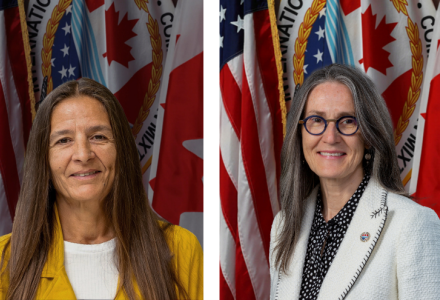
IJC welcomes the recent appointments to its boards.