Volume 23, Issue 2, 1998
July/August 1998


IJC Calls for Regular Government Inspection and Oversight of Dams

by Susan Bayh and Francis Murphy

The International Joint Commission has concluded that regular government inspection or oversight is necessary to insure dams along the U.S.-Canada border are safe. The Commission has found that some dams and dikes along the border in Canada are not subject to regular government inspections and that, although the situation is better, there are also dams in the United States that are not inspected regularly.

There are good reasons for addressing the safety of regulated facilities -- dams and dikes subject to Commission jurisdiction -- at this time. Many of them were constructed over 30 years ago. A failure of one of these dams could have serious, if not catastrophic consequences for persons and property in both countries. Although age alone does not determine their useful life, engineered structures do not last forever. To remain safe, dams require proper inspection, maintenance and repair programs, and the establishment and regular testing of emergency procedures.

In recent years, the Commission has reviewed the terms of some of its orders of approval for the construction and operation of such structures. It has become aware that some of its regulated facilities are in need of repair and that some existing programs have not insured that these repairs were made. These concerns have led the Commission to take stock of measures in place for assessing and ensuring the stability of its regulated facilities and responding to any emergencies.

Existing legislation, regulations, practices and government oversight are insufficient to insure that regulated facilities are safe. This does not necessarily mean that any regulated facilities are unsafe, but the Commission does not have full confidence in all existing safety programs.

Government oversight alone does not insure safety. Safety depends on the content of government programs and on the way in which those programs are implemented.

The Commission, nevertheless, is concerned about the absence of any government oversight of regulated facilities in New Brunswick and Ontario. Regulated facilities in British Columbia are no longer subject to regular government inspections. Oversight in that province is now based primarily on audits and monitoring instead of regular government inspections.

The Commission's Role

The Boundary Waters Treaty of 1909 requires that certain projects that affect the natural level or flow of waters along the boundary be approved by the Commission, unless they are provided for in a special agreement between the United States and Canada.

When considering applications for the approval of regulated facilities, the Commission must follow certain principles set out in the treaty. These include requirements for the protection of interests in the other country if the works increase natural levels. The Commission's orders generally contain conditions concerning the maintenance and operation of regulated facilities and specify limits or operating bands for water levels and flows. Furthermore, the Commission almost always appoints boards of control to insure that regulated facilities are operated in accordance with its orders.

In February 1997, the Commission held a public hearing in Ottawa, Ontario to obtain information about the safety of regulated facilities. Representatives from a number of the facilities' owners presented testimony.

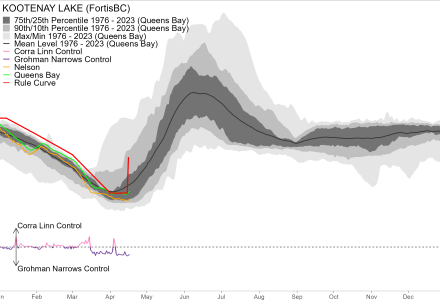
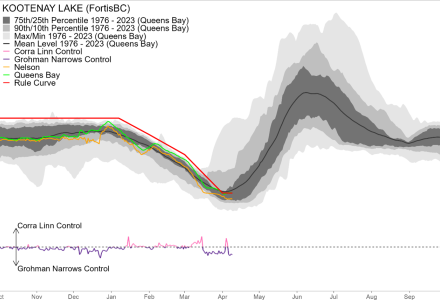
In the summer and fall of 1997, the Commission visited the Milltown and Grand Falls Dams on the St. Croix River and the Corra Linn Dam at the outlet of Kootenay Lake. During these visits, Commissioners spoke with the owners' staff about maintenance and emergency preparedness practices. In spring 1997, the Commission attended Ontario Hydro's annual Emergency Preparedness Plan Coordination Meeting and the New York Power Authority's emergency action plan exercise for the St. Lawrence-FDR Power Project.

Information obtained from hearings, responses to inquiries and on-site visits provided the basis for the Commission's findings and report to the U.S. and Canadian governments.

Findings

Some regulated facilities were built early in the century. With aging facilities, maintenance programs are an absolute necessity. Continuing maintenance programs are being implemented in some cases. Monies that owners budget for maintenance work are, however, sometimes not spent. One reason is that such expenditures are discretionary and market forces impose other priorities.

There is considerable variation in how regulated facilities are inspected. Those owned and operated by U.S. federal agencies are inspected by those agencies. The U.S. Army Corps of Engineers conducts inspections every five years and the U.S. Bureau of Reclamation conducts inspections every three years. The U.S. Forest Service conducts visual inspections annually and safety inspections every five to 10 years. The Federal Energy Regulatory Commission (FERC) inspects structures subject to its oversight. FERC engineers inspect structures with high and significant hazard potential annually and those classified as having low hazard potential biennially.

In Canada, the only government dam safety program for regulated facilities at either the federal or provincial level is administered by the province of British Columbia.

Information provided to the Commission indicates that emergency action plans do not exist for all regulated facilities. Fortunately, there are plans for most high-hazard dams. Considerable variation exists among the plans. Even though failures could in some instances put cities and major highways at risk, the Commission has observed that emergency preparedness training is not always taken seriously by participants, and governments at all levels are not always fully involved. In some cases, such as in the Rainy Lake basin and St. Croix River, there are dams in series. In these situations, the failure of one dam might affect others downstream.

The Commission agrees with the Canadian Dam Safety Association that "the prime responsibility for public protection" ultimately rests with government.

Recommendations

The Commission recommends that governments oversee the safety of regulated facilities and include requirements for:

The Commission stated that if it did not receive a substantive response from the Canadian and United States governments by June 1, 1998 regarding how they are going to deal with the issues raised in this report, the Commission may consider amending its orders to require the owner of each regulated facility to provide the Commission periodically with a certified copy of a safety inspection report for the structure prepared by a government official.

The Commission attaches great importance to public safety and would welcome any views which the governments or others may have about how best to insure that regulated facilities are maintained and operated safely.

Susan Bayh is a Commissioner in the International Joint Commission's U.S. Section and Francis Murphy is a Commissioner in the Canadian Section. Copies of the report, "Unsafe Dams?" can be obtained at www.ijc.org/php/publications/html/safedam/unsafe.html on the World Wide Web, or from the Commission's Washington and Ottawa offices.

sommaire

La Commission mixte internationale a conclu quant à la nécessité d'inspections régulières ou d'une surveillance systématique de la part des gouvernements si l'on veut garantir la sécurité des barrages situés le long de la frontière canado-américaine. La Commission a constaté que certains barrages et digues se trouvant dans la zone transfrontalière du côté canadien ne sont pas soumis à des inspections gouvernementales régulières et qu'aux États-Unis, bien que la situation soit meilleure, certains barrages ne sont pas non plus inspectés régulièrement. On peut obtenir une copie du rapport intitulé Des barrages sûrs? sur le réseau Internet à l'adresse www.ijc.org/php/publications/html/safedam/unsaff.html, ou en s'adressant aux bureaux de la Commission à Washington ou à Ottawa.