|
![]() November/December 1997 |
by Alice Chamberlin and Leonard Legault
Canada and the United States enjoy the closest and most cordial transboundary relationship between any two nations in the world, but global forces of change could stress their transboundary environmental relationship in the 21st century. The International Joint Commission has concluded that protecting and strengthening this friendship will require a blend of familiar mechanisms such as the 1909 Boundary Waters Treaty and new approaches such as watershed-based problem solving.
Responding to an April 16, 1997 request from the Canadian and U.S. governments to propose "how the Commission might best assist the Parties to meet the environmental challenges of the 21st century," the Commission, in October 1997, submitted recommendations that call for capitalizing on the unique flexibility provided by the 1909 Boundary Waters Treaty. The treaty, which created the Commission, has served the two nations well and may, in fact, be more essential to the governments in its second century than it was in its first.
A primary recommendation is that the two nations heed the positive lessons of the 1972 and subsequent Great Lakes Water Quality Agreements, which have contributed significantly to the restoration of the world's largest freshwater ecosystem. Stimulating a bottom-up, basinwide approach to identifying and solving problems, the Agreement has supported a Great Lakes community, which in itself has strengthened Canadian-U.S. ties.
The Commission proposes the staged creation of a series of international watershed boards spanning the entire U.S.-Canada border region. Using the ecosystem approach pioneered by the Commission, its Great Lakes boards and the governments under the Agreement, these boards would include members of the public, key officials of local, state and regional governmental bodies, and others with relevant knowledge of the particular watersheds affected.
The boards would help prevent transboundary conflicts while facilitating the resolution of those conflicts that do arise. They would monitor, alert, study, advise and report on a range of transboundary environmental and water-related issues. They could also serve in an ombudsman-like role by receiving, considering and investigating comments and complaints from the public.
Additional Commission proposals are listed below.
The Commission's response to the charge from the governments builds a foundation for these recommendations by analyzing the Canada-U.S. boundary relationship and the Commission's role in it. This suggests that practices developed during its more than eight decades of operation make the treaty an instrument flexible enough to anticipate and respond to the growing environmental challenges the two nations will face.
The response identifies four key forces of change that will affect transboundary environmental conditions.
Population growth and urbanization will have significant impacts. The Canadian population is expected to grow by over 15 percent to about 35 million by the year 2025, while the U.S. population is expected to rise over 20 percent to about 330 million by 2025. Ever-expanding urban areas will contribute to loss of essential land resources while the growing population consumes increasing amounts of resources such as water, timber, hydrocarbons and food.
Climate change is expected to influence transboundary conditions. Although some uncertainty persists, the likelihood of significant climate change in the 21st century poses critical questions in the transboundary region. Warming temperatures could lower river and stream flows while drying soils and increasing irrigation demands. While droughts may increase, the severity of flooding also may rise, causing soil erosion and sediment transport and increased disruption of populations along the border.
Economic expansion, energy demands and waste generation could create conflicts. The nations' expanding economies are likely to increase emissions of greenhouse gases, outputs of toxic substances, and household and industrial waste generation.
Environmental awareness will stimulate demand for citizen participation in decisionmaking. Since the 1970s, despite fluctuations, there has been a clearly increasing public interest in the environment and in government policies affecting it. The Commission believes the public will insist on an even greater role in the 21st century.
The Commission's response to the charge describes environmental challenges that will likely result from these forces, including changes in water quality, supply and demand; air pollution; toxic chemical use and release; habitat loss and biological diversity; exotic species; waste management; nuclear issues; and infrastructure needs.
Also facing the governments are challenges related to citizen participation and the role of science in public policymaking. Institutional challenges include the downsizing of governments and loss of environmental monitoring capacity, the fragmentation of governmental jurisdictions, and the roles of various international bodies. The Commission seeks to develop a cooperative working relationship with the Commission on Environmental Cooperation, established under a side agreement to the North American Free Trade Agreement, and other existing international, regional and state-provincial bodies.
The Commission's proposals emerge from an emphasis on its core mission of anticipating and resolving transboundary environmental disputes, a clear and careful delineation of its role to avoid duplication of effort with other institutions and its successful experience with inclusive processes that emphasize local participation and joint fact-finding.
Canada and the United States enjoy harmonious relations in spite of the asymmetry of power, economic development and population size and distribution that characterizes them. Asymmetry of population and economic development in particular boundary areas can contribute to conflict over water supplies and pollution. Different political systems, federal systems, constitutional systems, legal and regulatory regimes, and geography and climate can generate irritants at times. These inherent sources of conflict could be exacerbated by both the challenges the Commission has identified and by unforeseen problems that may arise in the 21st century.
The Commission's proposal to establish coast-to-coast watershed boards equips the two nations to deal with these problems in several ways. First, it provides an early warning system for potential conflicts, which are often first detected at a local level. Second, it addresses the problem of asymmetry by continuing in the Commission's tradition of equal representation from both nations. Third, it answers the call for public participation by including appropriate members of the public on the boards and assuring they will hear all interested parties. Finally, it calls for continuing the Commission's own traditional practices of consultation and consensus-building, engaging local governments, joint fact-finding, objectivity and independence and flexibility through the proposed international watershed boards.
The International Joint Commission is unique, a testament to the vision and cooperative spirit of the Canadian and U.S. peoples. As the coming century poses new challenges to their relationship, the two nations have an opportunity to anticipate, prevent and resolve environmental conflicts by building on the Commission's long experience in addressing matters of concern along the boundary, and in so doing, to continue providing a model for the world.
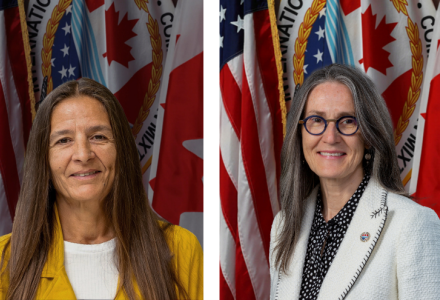
Leonard Legault is the chairman of the Commission's Canadian Section and Alice Chamberlin is a Commissioner of the U.S. Section. To receive a summary, or full text of the Commission's response to the charge from governments, contact a Commission office or visit its site on the World Wide Web at: www.ijc.org(.)
Revised: 24 December 1997
Maintained by Kevin McGunagle,
mcgunaglek@ijc.wincom.net